An electronic wristwatch represents a significant evolution in personal timekeeping, merging precision, functionality, and convenience into a compact wearable device. Unlike traditional mechanical or quartz analog watches, an electronic watch primarily uses a digital display—typically an LED (Light-Emitting Diode) or LCD (Liquid Crystal Display)—to present information numerically or alphanumerically. Its core is an integrated electronic circuit powered by a small battery, offering remarkable accuracy with minimal deviation.
Providing clean, accessible water is a fundamental requirement in all poultry production systems, from small backyard flocks to large-scale commercial operations. The choice of watering equipment significantly impacts bird health, welfare, and productivity. Modern poultry watering systems are designed to ensure an adequate supply of fresh water while minimizing waste, contamination, and labor. Here’s a breakdown of the main types.
1. Nipple Drinkers
The most prevalent system in modern commercial poultry houses (broilers, layers, breeders).
How they work: Stainless steel or brass nipple valves are installed at bird-level on a water line. Birds activate the valve by pecking at it, releasing water droplets directly into their beaks. Drip cups are sometimes placed underneath to catch minor spills.
| Model | 1260 | 1460 | 1660 | 1860 |
| Maximum strapping width: | 1210mm | 1410mm | 1610mm | 1810mm |
| Net Weight | 380kg | 410kg | 450kg | 500kg |
| Dimension(L W H) | 150X70X200cm | 170X70X200cm | 190X70X200cm | 210X70X200cm |
| Package size(L W H) | 165*850*220cm | 185*85*220cm | 205*85*220cm | 225*85*220cm |
| Load-bearing capacity | 80kg | |||
| Table height | 850mm | |||
| Maximum strapping height: | 420mm | |||
| Packing speed: | 20+packs/minute | |||
| Bonding method: | Bottom hot melt bonding | |||
| Use strapping tape specifications: | Width 5mm 脳 thickness 0.5-0.55mm; 11MM width can be customized | |||
| Power supply | 1P.220V.50Hz 0.6KW.10A (Rated current:1.1KW Rated current:4A) | |||
Advantages:
Excellent Water Hygiene: Water is enclosed within pipes, drastically reducing exposure to dust, litter, feed, and pathogens.
Water Conservation: Minimal spillage and evaporation, leading to significant water savings and drier litter.
Low Labor: Automated and connected to a regulated water line. Height is easily adjustable as birds grow.
Considerations: Requires birds to learn how to use them. Water pressure must be carefully regulated. Regular checking for clogging or leakage is necessary.
[table id=2 /]
2. Bell Drinkers / Round Drinker (Hanging or Floor-mounted)
Common in both small-scale and some commercial setups, especially for starting chicks.
How they work: A circular plastic dish is fed by a central water source from above (via a float valve or a suspended bottle). The shallow dish provides an open water surface.
Advantages:
Easy for Birds: Very intuitive, requiring no training. Easily visible.
Suitable for Chicks: Often used as starter drinkers.
Simple and Robust: Few mechanical parts.
Considerations:
Hygiene Risk: Open water is easily contaminated with litter, feathers, and droppings, requiring frequent cleaning.
High Spillage: Leads to water waste and very wet litter around the drinker.
More Labor-Intensive: Need regular refilling (if manual) and cleaning.
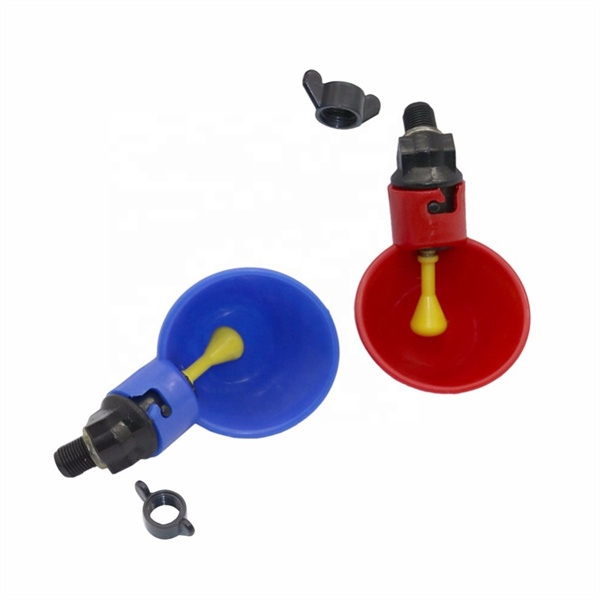
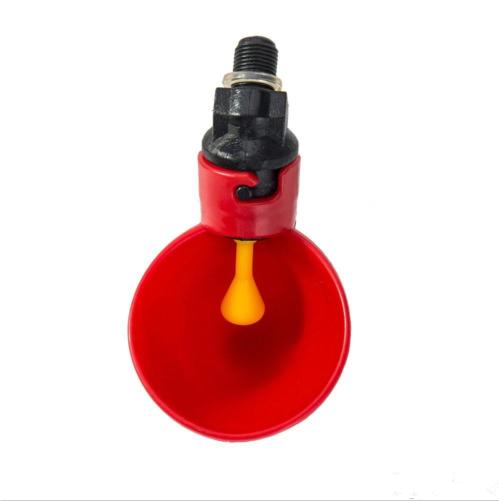
3. Cup Drinkers
Used in various production systems, often for pullets, layers, and turkeys.
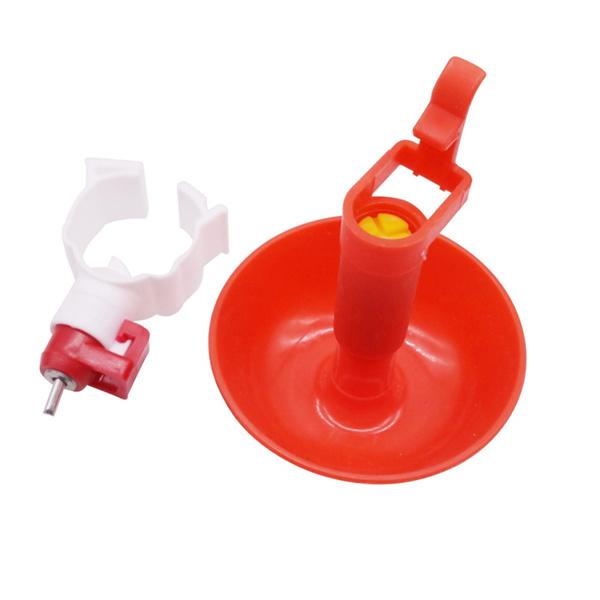
How they work: Small plastic cups are mounted on a water line. A trigger mechanism (usually a paddle or pin inside the cup) is activated when a bird drinks, filling the cup with fresh water from the line.
Advantages:
Good Hygiene: Better than bell drinkers as water is not continuously exposed, but not as closed as nipple systems.
Visible Water: Birds can see the water in the cup, encouraging drinking.
Reduced Spillage: Spillage is mostly contained within the cup.
Considerations: Cups need regular cleaning to remove feed or debris. Mechanical parts can sometimes fail.
4. Trough Drinkers
Linear channels of water, less common in modern intensive systems but used in some aviary or free-range setups.
How they work: A long, narrow trough is continuously supplied with a shallow stream of fresh water.
Advantages: Allows multiple birds to drink simultaneously.
Considerations: Very high risk of contamination and high water usage. Requires diligent cleaning and a slope for water flow. Not recommended where high biosecurity is needed.
Tell us about your project needs, and our experts will provide you with a tailored equipment quote and professional advice.
+8615631704336
czseo@yqlseo.cn
adress:Cangzhou Economic Development Zone, Hebei Province, China
Your partner in designing and delivering tailored, innovative project strategies for exceptional outcomes and sustainable growth.